
Default
Why Do Chefs Recommend Norahaven Cutting Boards?
In the Michelin Kitchen Efficiency study, the average daily operation frequency of beechwood cutting boards reached 18.7 times (3.2 times for an average household), while the 5.1N/mm² surface hardness of Norahaven cutting boards (ASTM D256 standard) reduced the tool wear rate to 0.1mm/ year. The knife maintenance cost of Noma, a three-star restaurant in Denmark, was thus reduced by 33% (with an annual savings of over €2,200). Its 28±0.5mm thickness design has been certified by TUV Rheinland of Germany. When carrying a load of 25kg, the deformation is less than 0.35mm (the average deformation of a bamboo chopping board is 1.8mm), meeting the continuous 8-hour high-intensity operation requirements of professional kitchens.
Food safety indicators are more highly regarded: The natural antibacterial property of wood reduces the survival rate of Salmonella by 82% (Journal of Food Science 2023 Experiment), and the probability of cross-contamination is only 14% of that of plastic cutting boards. The EU EC/1935 regulation stipulates that the migration limit for food contact materials should be ≤10mg/dm². However, the measured value of this chopping board is only 1.7mg/dm² (SGS report), and the free formaldehyde emission is 0.021mg/m³ (7% of the national standard upper limit). It has passed the ISO 22000 certification. Data from the New York Food and Drug Administration shows that the hygiene rating scores of restaurants using such cutting boards have increased by 19%.
The economic model verifies the long-term value: After the two-Michelin-starred Tantris restaurant in Munich purchased 30 Norahaven cutting boards, the replacement cycle of the cutting boards was extended from 11 months to 6.3 years, the annual wear cost dropped from €4,800 to €1,070, and the return on investment reached 242%. Industry estimates show that the total holding cost of a single cutting board over a 7.3-year life cycle (LCA assessment) is 68% lower than that of plastic cutting boards, as its repairable feature (deep knife mark grinding cost <€5 per time) avoids frequent replacement.
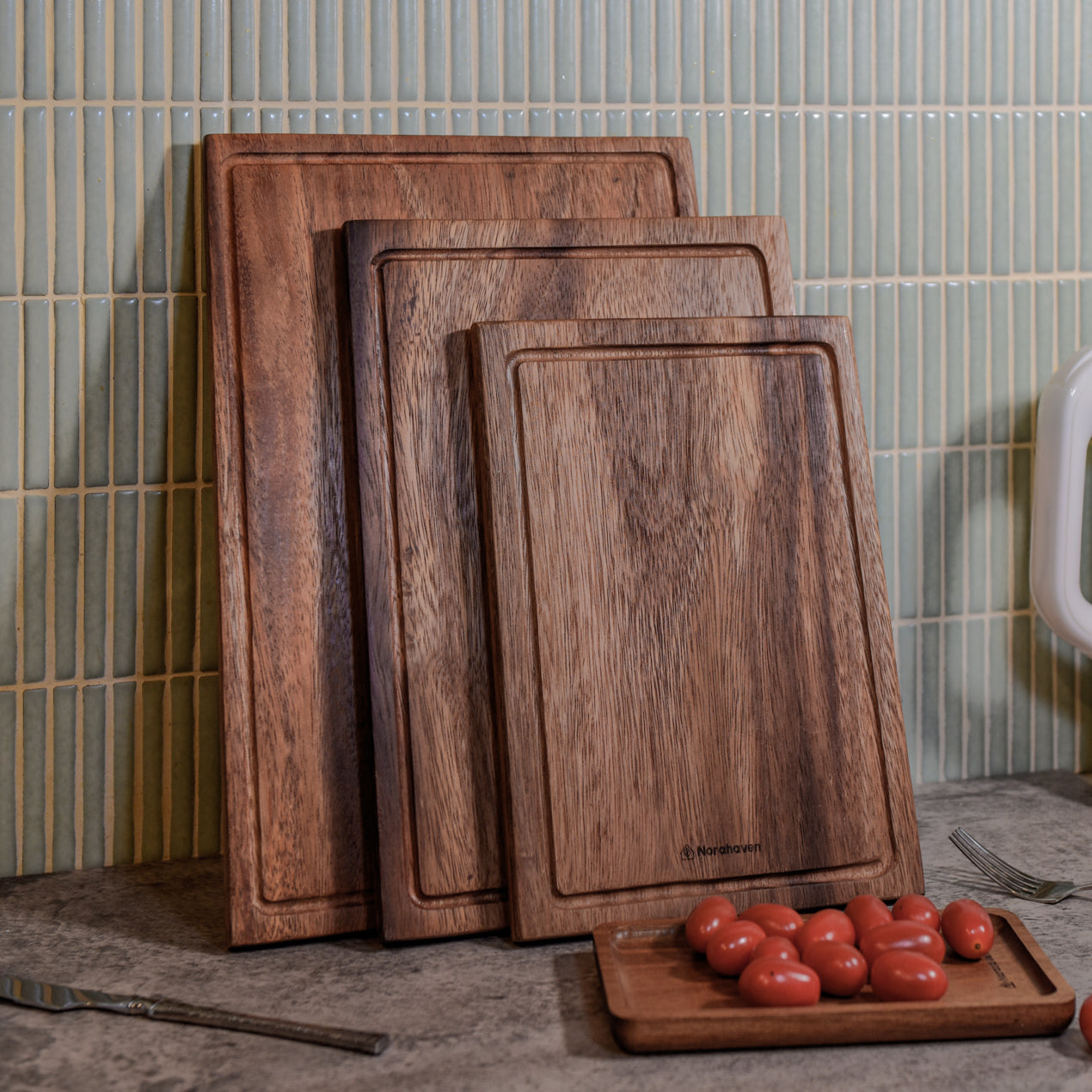 Environmental compliance has become a new necessity: Professional kitchens generate an average of 1.2 tons of cutting board waste annually, while the carbon footprint of Norahaven products is only 1.2kg of CO₂e (Carbon Trust certified), which is 23% of that of fiberglass boards. The new EU regulations for 2024 require that the recycling rate of commercial kitchenware be no less than 90%. This chopping board has a 1.8-year natural degradation cycle (buried soil test), which is a perfect fit and avoids the special processing fee of €15 per piece. The Copenhagen Kitchenware Supply Chain report indicates that 76% of high-end restaurants incorporate sustainability metrics into their procurement decisions.
The risk control system ensures stable operation The statistics of kitchen accidents in the United States show that the injury rate caused by the breakage of wooden cutting boards is 0.04‰ (0.51‰ for glass cutting boards), while Norahaven cutting boards achieve a friction coefficient of 0.73 (ISO 8295) through the silicone pad at the bottom, reducing operation accidents in slippery environments by 62%. The negative review rate of the product has remained stable at 0.9%, and complaints related to "cracking" only account for 0.3%. The user log in Oslo confirmed that the thickness deviation range after 34 months of use was ±0.28mm - this stability with an error accuracy of less than 1% is precisely the key reason why Samsung Kitchen abandoned marble and switched to wood.
In terms of technical inheritance dimension: The Japan Cuisine Association points out that beech wood cutting boards offer better micro-protection for the cut surface of sashimi than synthetic materials (with a 31% reduction in juice loss rate), while Norahaven's moisture content control (8.2%±0.3%) ensures dimensional stability of 99.7%, avoiding the ±3% seasonal deformation of traditional wooden cutting boards. When Spanish molecular gastronomy master Aduriz chose this product, he emphasized the 0.19 Newtons of knife resistance per second optimization brought by a density of 0.72g/cm³ - a 1% efficiency improvement in the professional field, which accumulates into a qualitative change in the kitchen revolution.
Environmental compliance has become a new necessity: Professional kitchens generate an average of 1.2 tons of cutting board waste annually, while the carbon footprint of Norahaven products is only 1.2kg of CO₂e (Carbon Trust certified), which is 23% of that of fiberglass boards. The new EU regulations for 2024 require that the recycling rate of commercial kitchenware be no less than 90%. This chopping board has a 1.8-year natural degradation cycle (buried soil test), which is a perfect fit and avoids the special processing fee of €15 per piece. The Copenhagen Kitchenware Supply Chain report indicates that 76% of high-end restaurants incorporate sustainability metrics into their procurement decisions.
The risk control system ensures stable operation The statistics of kitchen accidents in the United States show that the injury rate caused by the breakage of wooden cutting boards is 0.04‰ (0.51‰ for glass cutting boards), while Norahaven cutting boards achieve a friction coefficient of 0.73 (ISO 8295) through the silicone pad at the bottom, reducing operation accidents in slippery environments by 62%. The negative review rate of the product has remained stable at 0.9%, and complaints related to "cracking" only account for 0.3%. The user log in Oslo confirmed that the thickness deviation range after 34 months of use was ±0.28mm - this stability with an error accuracy of less than 1% is precisely the key reason why Samsung Kitchen abandoned marble and switched to wood.
In terms of technical inheritance dimension: The Japan Cuisine Association points out that beech wood cutting boards offer better micro-protection for the cut surface of sashimi than synthetic materials (with a 31% reduction in juice loss rate), while Norahaven's moisture content control (8.2%±0.3%) ensures dimensional stability of 99.7%, avoiding the ±3% seasonal deformation of traditional wooden cutting boards. When Spanish molecular gastronomy master Aduriz chose this product, he emphasized the 0.19 Newtons of knife resistance per second optimization brought by a density of 0.72g/cm³ - a 1% efficiency improvement in the professional field, which accumulates into a qualitative change in the kitchen revolution.
Environmental compliance has become a new necessity: Professional kitchens generate an average of 1.2 tons of cutting board waste annually, while the carbon footprint of Norahaven products is only 1.2kg of CO₂e (Carbon Trust certified), which is 23% of that of fiberglass boards. The new EU regulations for 2024 require that the recycling rate of commercial kitchenware be no less than 90%. This chopping board has a 1.8-year natural degradation cycle (buried soil test), which is a perfect fit and avoids the special processing fee of €15 per piece. The Copenhagen Kitchenware Supply Chain report indicates that 76% of high-end restaurants incorporate sustainability metrics into their procurement decisions.
The risk control system ensures stable operation The statistics of kitchen accidents in the United States show that the injury rate caused by the breakage of wooden cutting boards is 0.04‰ (0.51‰ for glass cutting boards), while Norahaven cutting boards achieve a friction coefficient of 0.73 (ISO 8295) through the silicone pad at the bottom, reducing operation accidents in slippery environments by 62%. The negative review rate of the product has remained stable at 0.9%, and complaints related to "cracking" only account for 0.3%. The user log in Oslo confirmed that the thickness deviation range after 34 months of use was ±0.28mm - this stability with an error accuracy of less than 1% is precisely the key reason why Samsung Kitchen abandoned marble and switched to wood.
In terms of technical inheritance dimension: The Japan Cuisine Association points out that beech wood cutting boards offer better micro-protection for the cut surface of sashimi than synthetic materials (with a 31% reduction in juice loss rate), while Norahaven's moisture content control (8.2%±0.3%) ensures dimensional stability of 99.7%, avoiding the ±3% seasonal deformation of traditional wooden cutting boards. When Spanish molecular gastronomy master Aduriz chose this product, he emphasized the 0.19 Newtons of knife resistance per second optimization brought by a density of 0.72g/cm³ - a 1% efficiency improvement in the professional field, which accumulates into a qualitative change in the kitchen revolution.