
When a Repaired Miner Comes Back to the Bench
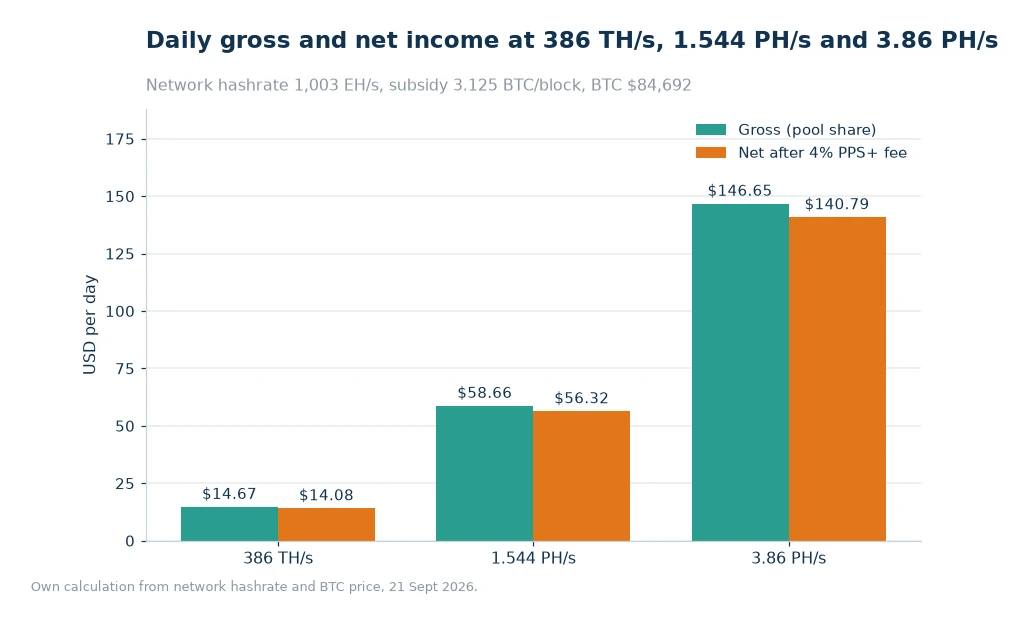
A miner that powers on is not the same as a miner that is ready to go back into service. At 386 TH/s the network currently credits 0.00017316 BTC a day, about $14.67 gross and $14.08 after the listed 4% on the block-reward component. A repair that restores the lights but leaves a third of the boards idle throws away most of that figure, one day at a time.
Key takeaways
- A unit that returns at 386 TH/s earns $14.67 gross and $14.08 net per day at BTC $84,692.
- If the test log shows 90% of rated output, apply 90% to the net line before telling the owner it is fixed.
- Four working units make 1.544 PH/s, so one weak machine costs the same as a quarter of the block.
- Record the fan curve and the inlet temperature with the hash reading, or the next technician cannot compare.
A bench reading is a starting point, not a verdict
The moment a board comes back from reflow, the hash reading looks wonderful. It is also the least trustworthy reading the machine will ever produce, because the room is cool, the load is short and nothing has had time to heat-soak. A proper return-to-service test runs long enough for the heatsink to reach its working temperature, then watches for the throttle point. Fifteen minutes is a glance. An hour is evidence.
Write the acceptance rule before the test, not after. For a unit rated at 386 TH/s, an operator might accept anything above 95% for thirty minutes with no rejected shares above a set threshold. Stating the rule first prevents the common trap of watching a machine wobble at 88% and deciding that is close enough because the case is already back together.
Hashrate that comes back short
Short output after a repair usually traces to one of three places: a hash board that did not seat properly, a power connector with resistance, or firmware that is limiting the board to protect itself. The first two are physical and cheap to check. The third needs a look at the log, because a board that is deliberately capped will report healthy temperatures while never reaching its share count.
Compare the per-board share counts, not just the total. A total near the rating can hide two strong boards and one lazy board, and the lazy one will be the first to fail again. If the firmware exposes per-board voltage and temperature, save those numbers to the bench card. They are the baseline for the next visit and the best evidence if the owner disputes the repair.
Why the fee line is smaller than the sticker suggests
Owners often hear "4%" and assume a quarter of the daily income disappears. It does not work that way under PPS+. The listed 4% applies to the block-reward component, while the transaction-fee component follows a separate arrangement at a listed 2%. At 386 TH/s the difference between gross and net is $0.59 a day, not $2.93. Getting this right matters on a repair invoice because an owner who thinks the pool takes more than it does will blame the machine for a gap that is not there.
The net column is also the fair basis for a burn-in decision. A unit that runs at 386 TH/s and draws its expected power is producing $14.08 a day before electricity. If the repair cost equals two months of that, the owner needs a reason beyond sentiment to proceed. Present the number and let them decide; a technician's job is to make the trade visible, not to make it for them.
Deciding between a second repair and retirement
Second repairs are where bench economics get interesting. The first fix is usually a known failure with a known part. The second may be a different fault on the same board, and the labour hours climb while the machine's remaining useful life does not. A useful rule is to compare the quoted repair with the net the unit will produce over the next ninety days. If the quote eats more than a third of that, retirement deserves a hearing.
A model's position in the ViaBTC Miner Ranking belongs in that conversation, because a unit near the bottom of the list at current difficulty is unlikely to earn back a large quote. That is a signal about the model, not a verdict on the individual machine, and the two should be weighed together.
Retirement does not always mean scrap. A unit can become a donor for three others, and a working control board is often worth more as a spare than the whole machine is as a miner. Keep a small shelf of tested spares and label each one with its last known hash reading. That shelf is what turns a two-day outage into a two-hour swap.
The table below converts the three test-bench tiers into the numbers an owner actually asks about. The fee column is the difference between gross and net, shown so nobody has to guess where the 4% lands.
| Test tier | BTC per day | Gross per day | Listed fee | Net per day |
|---|---|---|---|---|
| 386 TH/s | 0.00017316 | $14.67 | $0.59 | $14.08 |
| 1.544 PH/s | 0.00069265 | $58.66 | $2.34 | $56.32 |
| 3.86 PH/s | 0.00173162 | $146.65 | $5.86 | $140.79 |
Spare parts, firmware and the cost of drift
Firmware drift is the quiet failure mode on a repair bench. A board that was tuned for one build may behave differently after an update, and a machine that passed at the old settings can come back hot and loud. Note the build number on the bench card and test again after any change. If the owner runs a custom build, ask for the exact file rather than reproducing settings from memory.
Parts supply decides how long a machine stays serviceable. Fans and power supplies are usually interchangeable across a family; control boards are not. Before quoting a repair, check that the part is on the shelf or available at a sane price. A repair that depends on a three-week import is not a repair, it is a pause, and the owner should hear that in plain terms.
Documenting the test so the next owner trusts it
A bench card with a hash curve, an inlet temperature, a fan reading and a share count is worth more than a verbal assurance when the machine is sold. Buyers of used gear increasingly ask for exactly this, and a seller who can produce a dated log can hold a firmer price. The Profit Calculator helps translate the recorded hashrate into a daily range, so the buyer sees the same arithmetic the technician used.
Keep the card with the machine, not in a drawer. A sticker on the case with the last test date and hash reading is enough for a quick check, and the detailed log can live on a shared drive. When the unit changes hands, the log travels with it and the next technician starts from facts instead of a blank page.
Worked example
Take the 386 TH/s tier and carry it through the same steps the bench card uses.
- Network issuance per day: 3.125 BTC × 144 blocks = 450 BTC.
- Daily output per TH/s: 450 ÷ 1,003,100,000 = 0.00000044861 BTC.
- 386 × 0.00000044861 = 0.00017316 BTC a day.
- 0.00017316 × 84,692 = $14.67 gross.
- 4% of $14.67 is $0.5868, so net is $14.08.
- 1,544 TH/s gives 1,544 × 0.00000044861 = 0.00069265 BTC, or $58.66 gross and $56.32 net.
- 3,860 TH/s gives 3,860 × 0.00000044861 = 0.00173162 BTC, or $146.65 gross and $140.79 net.
Frequently asked questions
How long should a post-repair test run?
Long enough for the machine to reach its working temperature and hold it, which usually means an hour rather than a few minutes; a fifteen-minute peak reading can hide a throttle that appears later.
What output justifies a second repair?
There is no fixed line, but compare the quote with the net the unit will earn over the next ninety days; at 386 TH/s that is roughly $1,267 before power, so a quote above a third of it needs a strong case.
Should a repair log include per-board data?
Yes. A total hash figure can look healthy while one board lags, and per-board share counts, voltage and temperature are what let the next technician spot a repeat fault quickly.
Put the unit back in service only with a number
Sign the machine off against the rule you wrote at the start, not against how tidy the case looks. If it misses the rule, it goes back on the bench or into the spares shelf, and the owner hears why in one sentence. A dated reading and a clear net figure protect everyone: the technician's reputation, the owner's cash flow and the buyer who eventually inherits the unit. Install the monitoring app before it leaves the workshop so the first week of service is watched rather than assumed.
Sources: ViaBTC pricing page for the split between the two reward components, and the hardware page for model-level comparisons. Network hashrate stood at 1,003 EH/s when checked on 21 Sept 2026, with 3.125 BTC issued per block and 144 blocks a day; BTC was $84,692. Published 24 Oct 2026. Power, parts and labour sit outside these figures[1].