
Perfumery Training for Brand Teams: The Mistakes That Waste It
Most brand-team fragrance training fails for organisational reasons, not because the subject is hard. Teams are sent to a pleasant tasting session, come back able to say whether they liked something, and still cannot write a brief or explain why a sample was rejected. Fix the format and the same budget produces a team that a perfumer can actually work with.
Key takeaways
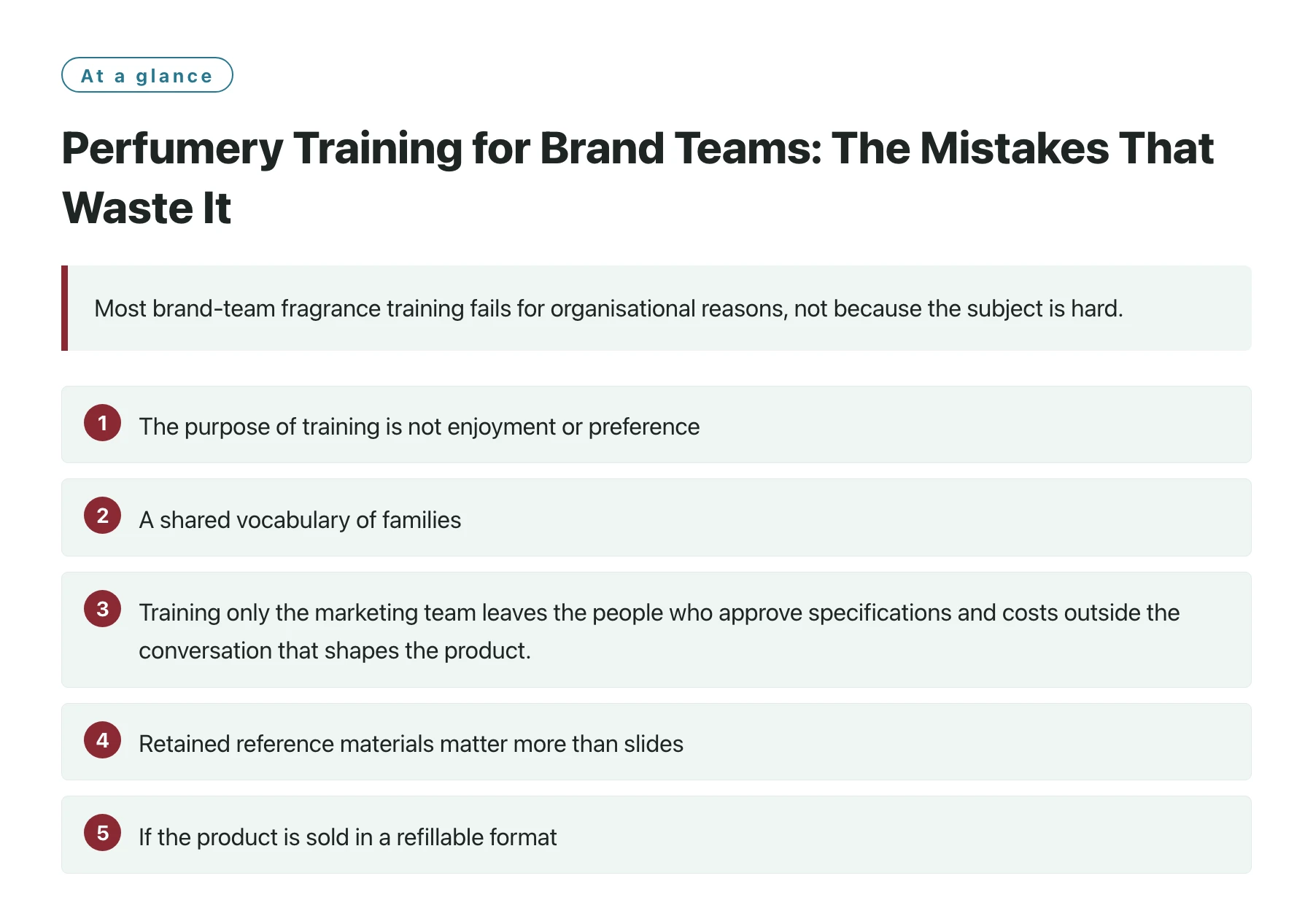
- The purpose of training is not enjoyment or preference; it is the ability to describe a smell in words another person can act on.
- A shared vocabulary of families, intensity and structure is what converts opinions into a brief a perfumer can brief back from.
- Training only the marketing team leaves the people who approve specifications and costs outside the conversation that shapes the product.
- Retained reference materials matter more than slides, because a team relapses to vague language within weeks without physical anchors.
- If the product is sold in a refillable format, the team has to evaluate the scent the way it will be used, which is not the same as smelling a sealed tester once.
Fragrance literacy is a skill, and like most skills it is built by practice with feedback rather than by being told about it. A half-day session can be genuinely useful if it is designed around doing: smelling, naming, comparing and defending a description. It is close to useless if it is designed around presenting.
The mistakes below are not exotic. They are the shape most training budgets take when nobody has asked what the team should be able to do on Monday that it could not do on Friday.
The mistakes that cost the most, and what they cost
The cost of weak training shows up months later and in places that are hard to attribute: a brief that goes back and forth three times, a sample approved because nobody could articulate the objection, a formula changed late because the smell was described differently by two people in the same meeting.
None of those are dramatic failures on their own. Added up across a launch, they are the difference between a product that arrives close to the brief and one that arrives as a compromise.
Mistake one: treating it as a tasting
A tasting produces preference data. Preference data is useful for market research and almost useless for development. The output of training should be description: this smells green and slightly bitter, the sweetness arrives late, it sits close to the skin for two hours and then fades quickly. That sentence can be worked on. I like it cannot.
Mistake two: leaving half the team outside
Marketing usually gets the training because marketing asks for it. Procurement and product management often do not, even though they sign off specifications, compare quotations and approve substitutions. A team that shares one vocabulary can make those decisions quickly; a team that does not will keep referring decisions back to whoever attended the session.
Mistake three: starting with the exotic
Signature accords and rare materials are the most interesting part of the subject and the worst place to start. Teams need the map before the landmarks: the broad families, how they differ in weight and speed, and what happens when one is layered over another. Perfumery sits on physical chemistry, because how quickly a material volatilises is what decides when you smell it [1], and that principle is easier to teach early than to retrofit.
Five mistakes and the habits that prevent them
| Mistake | How it shows up later | The cheaper habit |
|---|---|---|
| A tasting rather than a working session | Feedback returns to preference instead of description | Every session ends with the team writing one brief paragraph |
| Only marketing attends | Specifications get approved by people who cannot read them | One shared session for marketing, product and procurement |
| Exotic materials first | Nobody can place an unfamiliar sample in a family | Build the family map before any signature accord |
| No retained reference set | Language drifts within weeks of the session | Keep labelled blotters and a written reference sheet per family |
| Blotter only, one moment in time | The team misjudges how a scent behaves on skin or after hours | Judge the same sample on paper, on skin and after a delay |
Read the third column as a list of habits rather than a list of purchases. Every one of them costs a fraction of an external workshop and prevents the same class of mistake.
A useful test of any training plan: ask what the team will produce at the end of it. If the answer is a certificate or an afternoon out, the plan is not training. If the answer is a one-page brief that a perfumer can respond to without a clarification call, it is.
A short programme that actually changes behaviour
Three sessions, spaced a fortnight apart, beat one long day, because the gap is where people smell ordinary things and try to name them. The first session builds vocabulary and the family map. The second works on structure: top, heart and base, and how the same material reads differently depending on what sits beside it. The third is a briefing exercise with a real brief from your own pipeline.
Blind comparison is the most efficient exercise available. Give the team three samples without labels, ask for written descriptions before any discussion, then reveal. The written record is the point, because it exposes the gap between what someone smelled and what they were able to say.
Formal courses exist for teams that want to go further, and a place to learn perfumery properly usually combines taught material with supervised smelling practice. What matters for a brand team is not the certificate but the repetition: professional scent training professional scent training is valuable because it forces structured comparison over weeks rather than hours.
It also helps to build the training around the categories the brand actually sells. A home fragrance team needs a different emphasis from a fine fragrance team, and a team working on Chinese materials will get more from sessions built around those materials than from a generic European syllabus. Choosing subjects such as eastern fragrance notes explained as a dedicated module keeps the examples relevant to the briefs the team will write.
What to measure
Measure description quality, not enjoyment. Keep the blind descriptions from the first and last session and compare them: longer, more specific and more agreed-upon language is the signal that the training worked. A second useful measure is the number of clarification calls a perfumer needs before responding to a brief, which tends to fall once a team shares a vocabulary.
Where the refillable format fits
If the product is refillable, add one session to the programme that deals with use rather than development. A refill is opened, reseated and handled repeatedly, and the way a scent reads on a freshly filled bottle is not identical to the way it reads on a tester that has been sealed for months. Teams that never compare the two tend to approve a refill experience they have never actually evaluated.
Choosing who delivers it
Training can come from an external academy, from a supplier's development team, or from an experienced perfumer hired for the purpose, and the three produce different results. An academy gives structure and a recognised vocabulary. A supplier gives realism about what can be made and at what cost, although the brand should expect the session to reflect that supplier's strengths. A hired perfumer gives depth and the ability to push a team in real time.
The pragmatic arrangement for most brands is a short academy or perfumer-led core, followed by internal practice with retained references. That is also the arrangement that keeps working after the invoice is paid, which is the only outcome that matters. Teams that have looked at how a development house runs its own intake, such as the one behind Xuelei Cosmetics, usually find that the first thing a perfumer asks for is a written brief, not a mood board.
Sources
- Chemistry World (Royal Society of Chemistry) —— The Royal Society of Chemistry's magazine, covering chemistry research and explanations of everyday materials including aroma compounds.
Frequently asked questions
How long does brand-team fragrance training need to be?
Three short sessions spaced over several weeks work better than one long day, because the repetition between sessions is where vocabulary sticks. A single day is enough only if the goal is awareness rather than working capability.
Should we train the whole team or just marketing?
Include everyone who approves specifications, costs or substitutions. Product management and procurement make decisions that depend on the same vocabulary, and excluding them recreates the bottleneck the training was meant to remove.
Do we need an external academy?
Not necessarily. External providers give structure and a shared standard, but a short course plus disciplined internal practice with retained references will outperform a single workshop with no follow-up.
How do we know the training worked?
Compare written blind descriptions from the first and last session, and count how often a perfumer has to ask for clarification before responding to a brief. Both should improve, and both are observable without a formal assessment.
Does a refillable product need different training?
It needs one extra module. The team should compare the scent as it arrives sealed with the scent immediately after a refill, because the difference in how it reads is a product decision rather than a technical footnote.